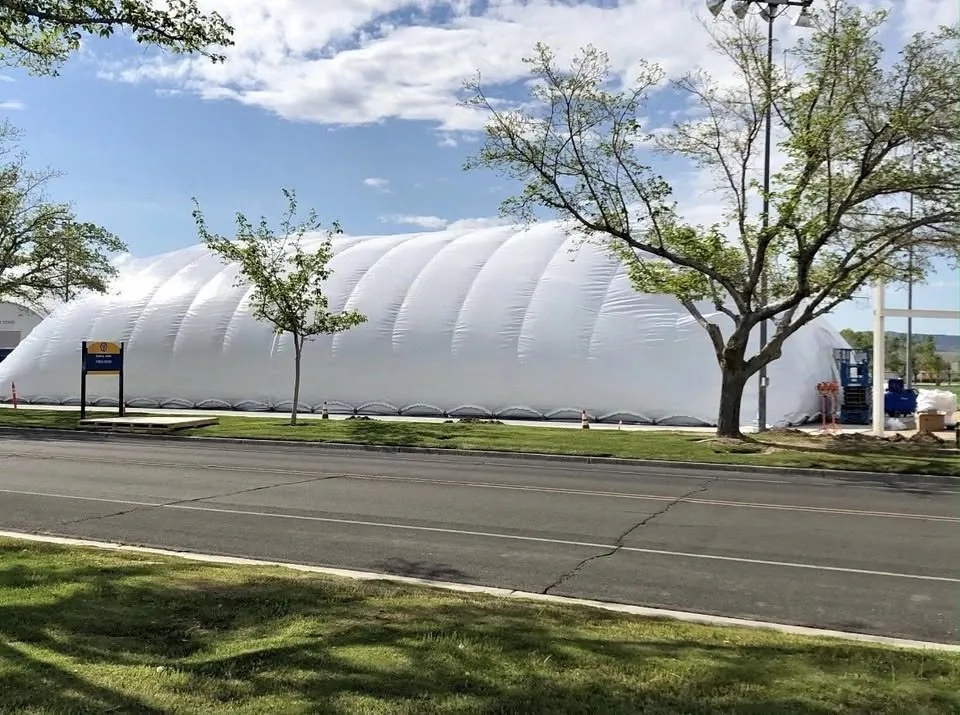
Used air dome for sale, 60' × 118' Arizon air-supported structure
Everything but the HVAC is included: 33 oz PVDF fabric, the Fizer inflation unit with its propane backup engine, both doors, all the lighting, the electrical panel, rubber floor for the full 7,080 sq ft, and the as-built drawings. Three years up in the desert, locked in dry storage ever since.
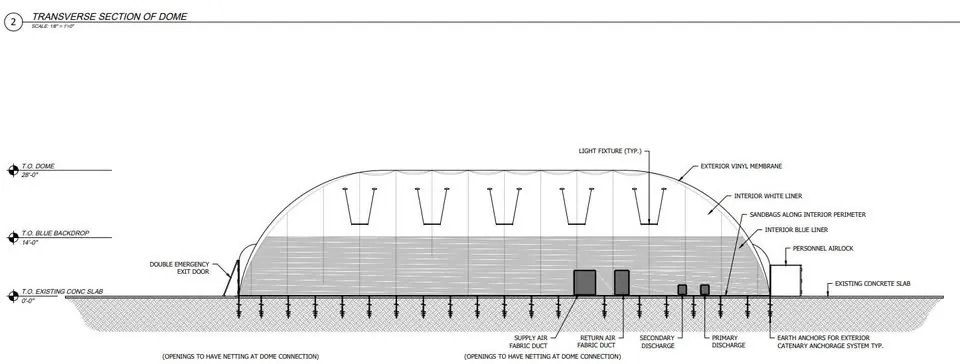
Section through the short axis, drawn to scale. Clear span, no interior columns.
Most used domes are half a building
Almost every used dome you will find is just fabric and a blower. Then you figure out you still need doors, lights, a panel and a floor, and the budget is gone before anything goes up.
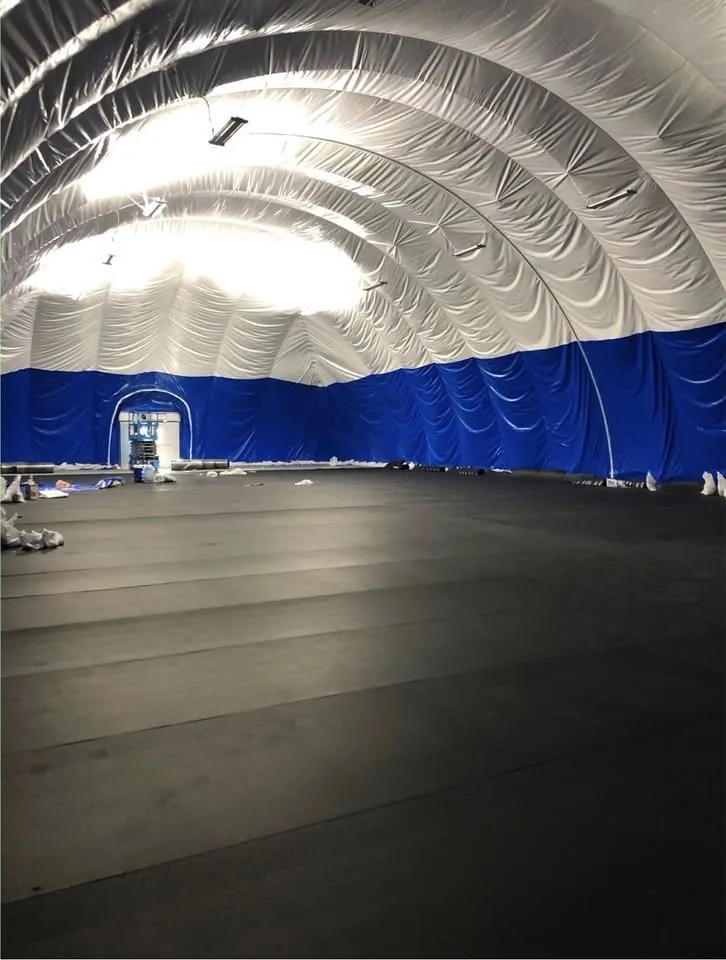
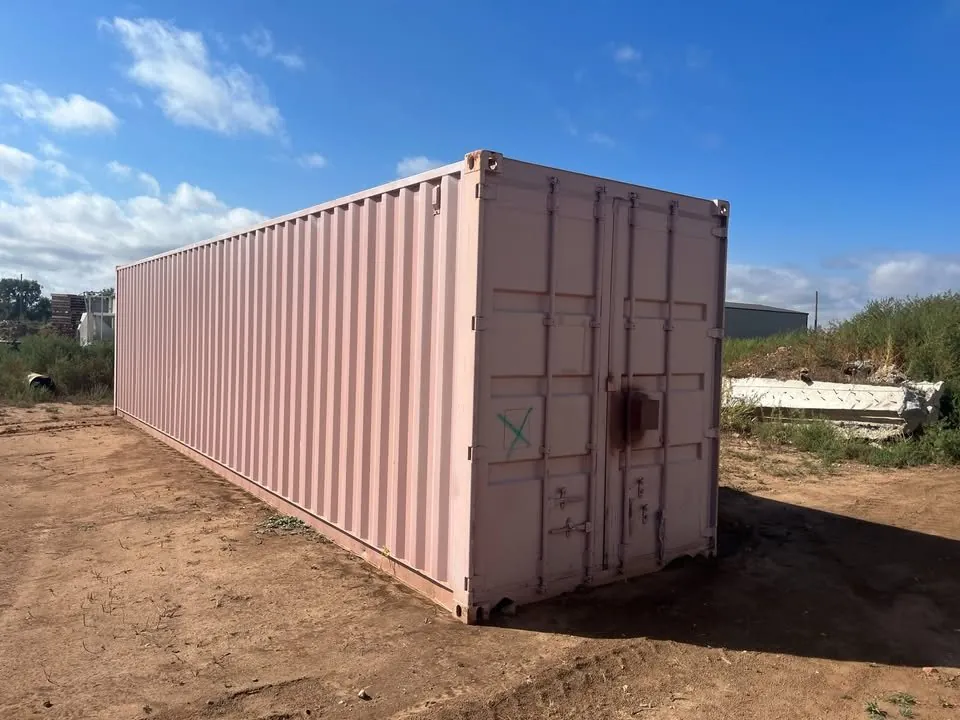
This one came down complete and went into storage complete. Airlock door, emergency door, the whole lighting harness, the electrical panel, and half-inch rubber mat for the whole floor, all of it in the container with the Arizon manual and the as-built drawings. The one piece not included is the HVAC unit, covered below.
What fits inside
At 60 by 118 it holds one tennis court with 20 feet of runback and 12 feet each side, above the recreational minimum of 56 by 114 and 1 foot per end under the 60 by 120 tournament guideline. Four pickleball courts at the recommended 30 by 60 need 120 feet, 2 feet more than this dome has, so check a four-court layout against the drawings. Pick a layout below.
Component manifest
Every line below is in the container and included at the asking price.
| Component | Specification | What it does |
|---|---|---|
| Fabric envelope | 33.3 oz/yd² PVDF-III, triple wall | The building itself. 550 lbs/in tensile, opaque, fire rated to NFPA 701. Entry-level PVC does not come close. Sold as-is, no warranty, see below. |
| Inflation unit | Fizer Model 24-2 | Primary and secondary electric inflation fans in one packaged unit, plus a propane backup engine that starts on its own if power drops or pressure falls. Inflation only, no heat. |
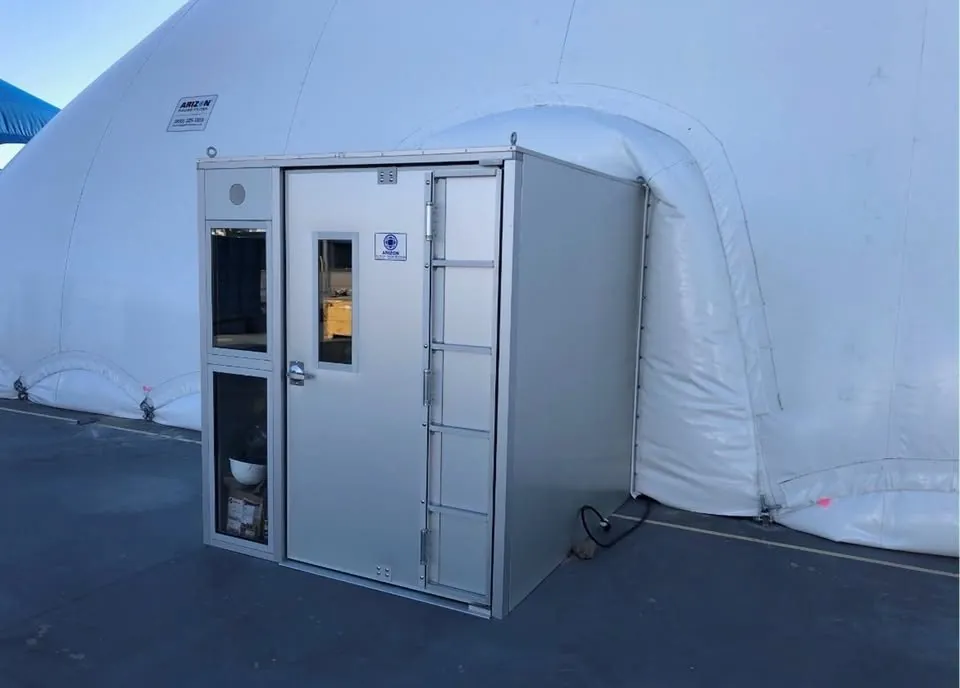
| Air lock door | Arizon, front entry | Personnel airlock with exit light. Holds internal pressure while people pass through. |
| Emergency door | Arizon, double leaf | Pressure-balanced emergency exit with panic hardware and exit light. |
| Lighting system | Flex Essentials LED high-bay, cord kit included | Full interior lighting with the suspension and cabling harness sized for this envelope. |
| Electrical panel | Standing panel | Feeds the inflation unit, lighting and interior outlets. Sized for 46 110V outlets; outlet wiring by your electrician. |
| Flooring | 1/2" rubber matting, full floor | Covers the entire floor. Has its own resale market if you would rather run a different surface. |
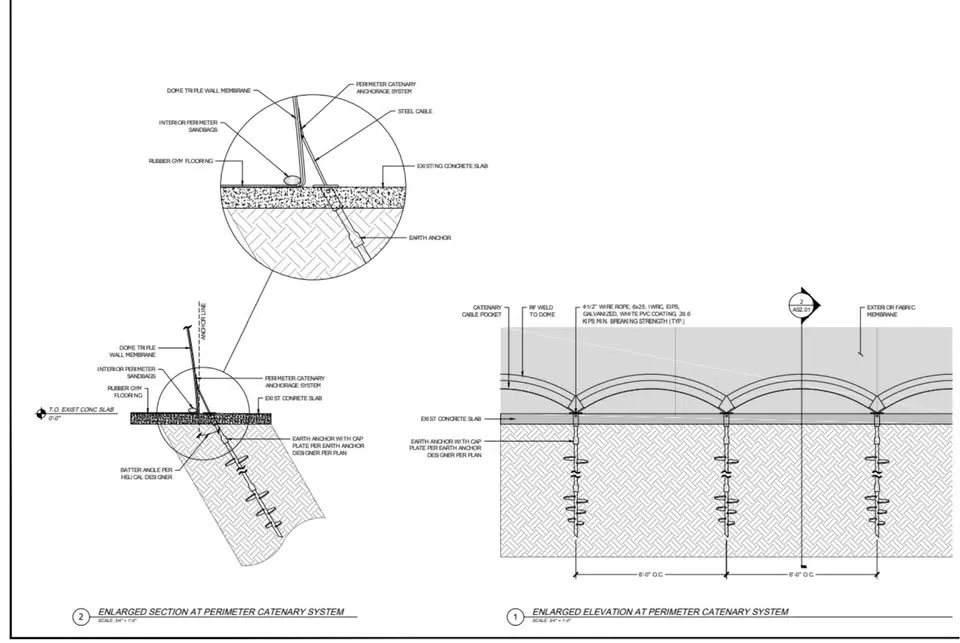
| Anchorage system | Perimeter catenary, 1/2" galv. wire rope | 6x25 IWRC EIPS with white PVC coating, 26.6 KIPS min. breaking strength, into helical earth anchors at 6' on center. No poured grade beam required. |
| Documentation | IOM manual + engineering submittal | Roughly 400 pages across two documents: as-built drawings, install and dismantle procedures, anchorage design, operating setpoints and data sheets for every component. Both published on this page. |
Everything on this page is pulled from the Arizon documents and our own records to the best of our ability. Confirm anything you are relying on against the documents themselves, the physical equipment, and your own engineer before you buy.
The fabric, by the numbers
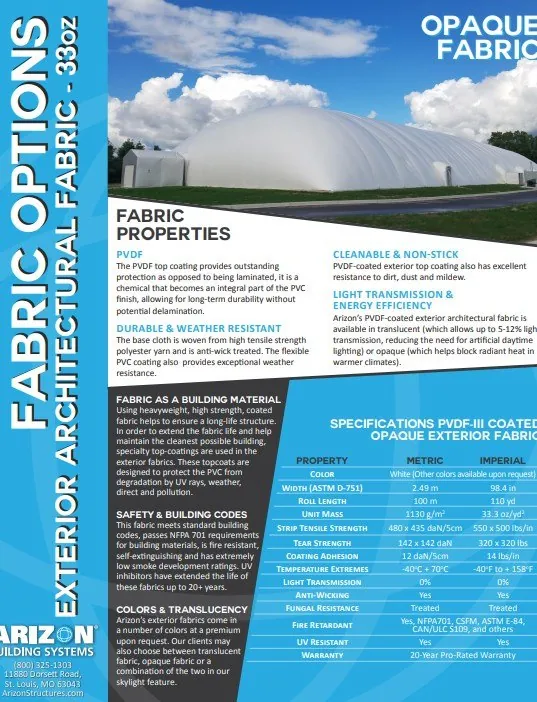
This is the manufacturer's published data for the exact material on this dome. Most used domes get sold on entry-level PVC. This is not that.
| Unit mass | 33.3 oz/yd² |
| Strip tensile strength | 550 × 500 lbs/in |
| Tear strength | 320 × 320 lbs |
| Coating adhesion | 14 lbs/in |
| Temperature range | -40°F to +158°F |
| Light transmission | 0%, opaque |
| Fire retardant | NFPA 701, CSFM, ASTM E-84, CAN/ULC S109 |
| UV resistant | Yes |
| Anti-wicking | Yes |
| Fungal resistance | Treated |
| Warranty status | Expired, see below |
Opaque fabric blocks radiant heat, which is why this one ran in the Mojave. If you want daylight instead, translucent fabric passes 5 to 12% light, but you give up the heat blocking.
There is no warranty on this dome
The numbers above are the manufacturer's published specification for this material. They are not a warranty. The original 20 year pro-rated coverage ran to the first purchaser on the original installation, and it does not come with the dome. We took it down ourselves without Arizon supervising, which ends it on its own, and coverage like this is not transferable to a second owner in any case.
It sells as-is. What you get instead of paper is the ability to look at it: come inspect the fabric in person, or have Arizon inspect it and quote you on a re-install, which is the only route to any kind of coverage going forward. We would rather tell you this up front than have you find out from your attorney.
Power and fuel
Power comes in from the utility to the standing electrical panel, which is included. The original drawings call for 208V three-phase service at the mechanical pad. From the panel it feeds three things: the Fizer inflation unit, the interior lighting and door exit lights, and the interior outlets. On the original site the same panel also fed the Trane HVAC unit, which has been sold.
Fuel is propane from a tank on site. On the original install it ran to two places: the Trane for heat, and the Fizer's backup engine. With the Trane gone, the only fuel draw in this package is the backup engine. It starts on its own if the power goes out or pressure drops, and it keeps the dome standing until power comes back.
| Connection | From and to | Notes |
|---|---|---|
| Utility service | Utility to standing panel | 208V three-phase on the original drawings. Service to the site is yours to bring in. |
| Inflation power | Panel to Fizer 24-2 | Runs the primary and secondary electric inflation fans. |
| Lighting | Panel to fixtures and exit lights | Circuits from the panel to the interior fixtures and the door exit lights. |
| Outlets | Panel to interior | Panel sized for 46 110V outlets. Outlet wiring by your electrician. |
| Backup fuel | Propane tank to backup engine | Tank not included. The engine starts on power loss or low pressure. |
| Heat and cooling | Panel and fuel to your HVAC | Not included. The original Trane ran off this same panel and propane supply. |
Your site needs three-phase power, a fuel supply with a regulator, a heat source if you run in the cold, and a licensed electrician and gas fitter to connect it all.
What is not included
The 50-ton Trane HVAC unit (heat and A/C)
We sold it separately. On the original install it did both jobs: 640 MBH of propane heat and 50 tons of cooling. The Fizer unit keeps the dome inflated but does not heat it, so budget for a heat source sized to your climate, and cooling if you need it. The original heating and cooling estimate is in the submittal as a starting reference.
Putting it up
Five stages. The foundation takes the longest and happens before anything ships. Once the pad is cured, a decent crew has this thing standing in under two weeks.
Site prep and foundation
Soil test, stamped drawings, permit, then either a concrete grade beam or earth anchors depending on your soil and local wind code. Concrete has to cure before it takes any load.
Delivery and unload
The container shows up from Amarillo. You will want an 8,000 lb forklift and flat ground to stage on. Lay everything out and check it against the manifest before your crew arrives.
Envelope layout and anchoring
Roll the fabric out across the pad, get it positioned, then bolt the perimeter down and fit the cable harness. Slow work and weather dependent. Do not try it on a windy day.
Mechanical and electrical
Set the Fizer unit, run the fuel line to the backup engine and to whatever heater you add, land the panel, hang the lighting harness. You need a licensed electrician and a gas fitter for this part, not general labor.
Inflation and commissioning
Set the airlock and emergency doors, inflate it, dial in the pressure setpoints on the photohelic gauge, lay the rubber floor. It comes up to pressure in a few hours.
You want somebody with construction experience on the job
This is not a weekend kit. Anchoring a pressurized fabric building, running gas and three-phase, and getting it through inspection is real trades work. If you have run commercial installs before, you will be fine. If not, get a GC involved or hire Arizon to put it up. They still build these and they have the records on this exact sales order.
Where it came from, and why we are selling
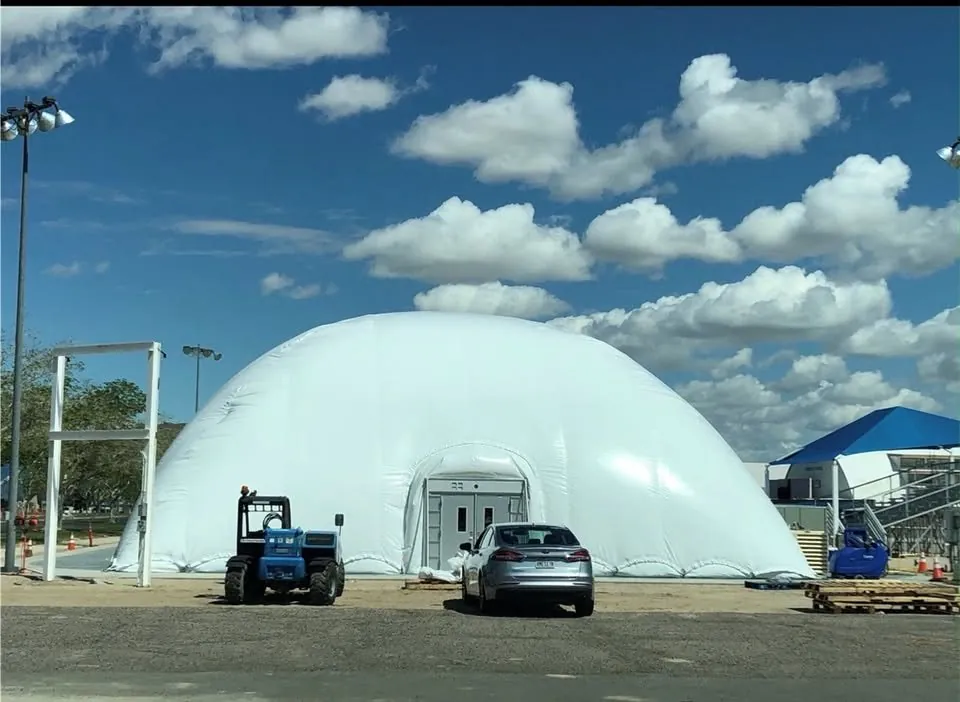
Arizon Building Systems built it in 2020 under sales order A10324. It went up on a military installation out in the California high desert and ran as the base gym from 2020 to 2023 while they built the permanent one.
We bought it to open our own facility. We took it down ourselves in 2023, packed it into a 40-foot high-cube container and hauled it to Texas. Then our funding fell through and the project died. It has been locked in a container in a dry storage facility ever since.
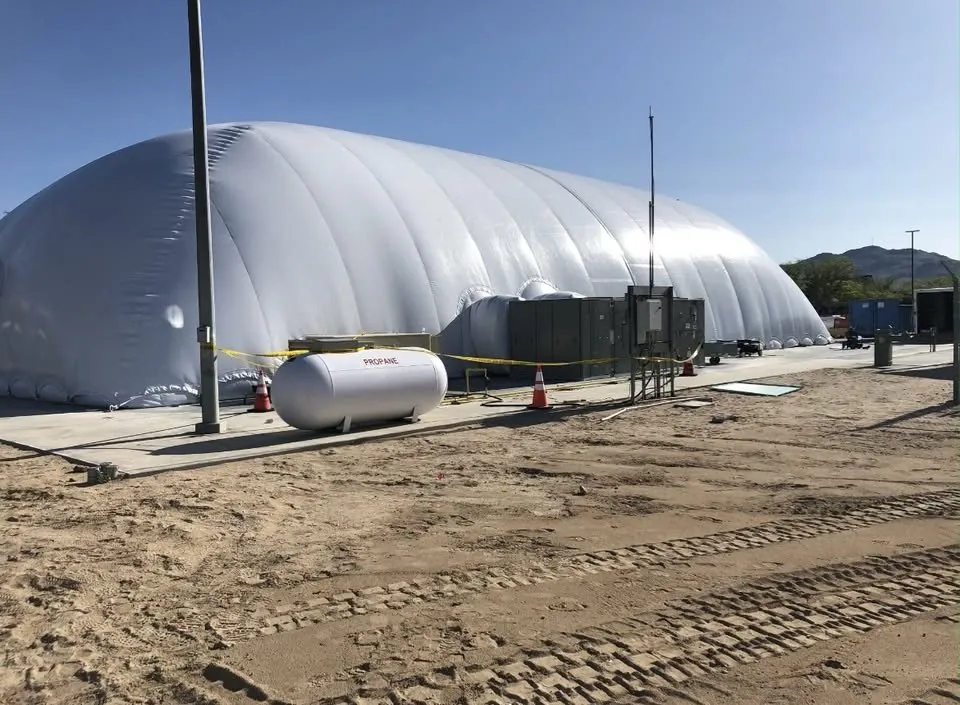
That is the whole story. Nothing wrong with the dome. We just do not have a use for it anymore, and it is worth a lot more to somebody who does than it is sitting in storage. Three years in the Mojave is about the easiest life fabric can have: no standing water, no freeze-thaw, no salt air.
You get the engineering, not just the parts
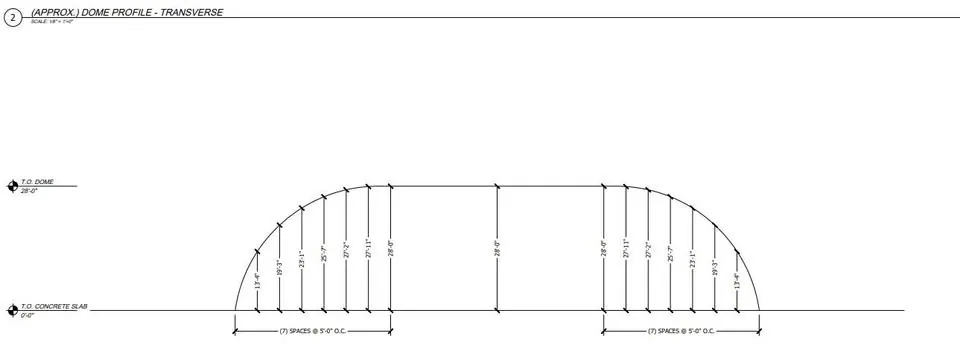
The as-built set comes with the dome. Sections, the profile with cable spacing, and the perimeter anchorage details. If you have ever tried to permit a used building with no paperwork, you know what this is worth.
Anchoring, and why it matters to your budget
This dome does not need a poured grade beam. It runs a perimeter catenary system: 1/2" galvanized wire rope, 6x25 IWRC EIPS with white PVC coating and 26.6 KIPS minimum breaking strength, tied to helical earth anchors at 6' on center, with sandbags along the interior perimeter. On its original installation it sat on an existing concrete slab.
If you already have a slab, a pad, or ground your engineer will sign off on, that is the single biggest line item in the whole project potentially off your budget. Confirm it with a local engineer against your own soil and wind code, but the system it was built for is anchors, not footings.
Read the paperwork yourself
Both documents are posted below. No form, no email required. Read them before you call, and every question you have will be a better one.
Arizon submittal package, Rev 2
The engineering package Arizon produced for approval before they built it. This is the design intent document: what the building is, how it was calculated, and what it was specified to do.
- Shop drawings, sections and the dome profile with cable spacing
- Perimeter catenary anchorage design and earth anchor layout
- Fabric data sheets for the exterior membrane and interior liners
- Door, lighting and inflation equipment cut sheets
Installation, operation and maintenance manual
The full operating manual that shipped with the dome, roughly 326 pages. This is what you would hand your crew and your operator. Large file, give it a moment to load.
- Installation and dismantling procedures, step by step
- As-built drawings
- Wind and snow operating setpoint tables and emergency procedures
- Fizer inflation unit and backup engine manuals
- Trane HVAC section, included for reference only since that unit was sold
Both open in Google Drive in a new tab. You can read them there or download a copy. They are the authority: where this page and the paperwork disagree, the paperwork wins.
Wind and snow operating setpoints
An air dome holds up with pressure, not steel. These are the actual numbers out of the Arizon manual, in inches of water column.
| Condition | Threshold | Pressure setpoint | Low needle | High needle |
|---|---|---|---|---|
| Normal wind | 0 to 35 mph | 0.90″ – 1.00″ | 0.70″ | 1.30″ |
| Heavy wind | 35 to 50 mph | 1.50″ – 1.60″ | 1.30″ | 1.80″ |
| Very heavy wind | 50 to 90 mph | 1.50″ – 1.60″ | 1.30″ | 1.80″ |
| Light snow | 1 to 2″ per hour | 1.50″ – 1.60″ | 1.30″ | 1.80″ |
| Heavy snow | 3″ per hour | 1.50″ – 1.60″ | 1.30″ | 1.80″ |
Engineered for its original California site: the documents cite a 110 to 120 mph design wind speed and a 5 psf ground snow load. Any new site needs its own engineering review for local wind and snow.
For snow you bring the inside up to 80°F two hours before it starts falling. That takes a heat source, which you supply. Full procedures come with the manual. Code background: ASCE and the International Code Council.
The dome, erected and packed
Location and shipping
Stored near Amarillo, Texas, in the Texas panhandle, which sits within a day's drive of most of the central United States. Exact address provided to serious buyers.
| Destination | Distance | Drive time |
|---|---|---|
| Oklahoma City | 260 mi | 4 hr |
| Dallas / Fort Worth | 360 mi | 5.5 hr |
| Denver | 440 mi | 7 hr |
| Kansas City | 570 mi | 8.5 hr |
| Phoenix | 760 mi | 11 hr |
What buyers usually ask
Why are you selling it?
Is everything really included?
Does it come with heat or A/C?
Do I need a concrete foundation?
What does the whole project cost, not just the dome?
Do I need a permit?
Can I install it myself?
How long does it take to put up?
What does it cost to run?
Does the fabric warranty transfer?
What condition is the fabric in?
Can it stay up all year?
What happens if the fabric gets punctured?
Is there anything unusual about the tax treatment?
Question not answered here? Ask it directly and I will give you a straight answer.
Come see it, or make an offer
The manual and the engineering submittal are both posted above, so there is nothing to request. What is left is the stuff that needs a conversation: come inspect it, talk price, or get a shipping quote to your site. Tell me where you are putting it and what for, and I will tell you straight whether it will work for you.